
Introduction
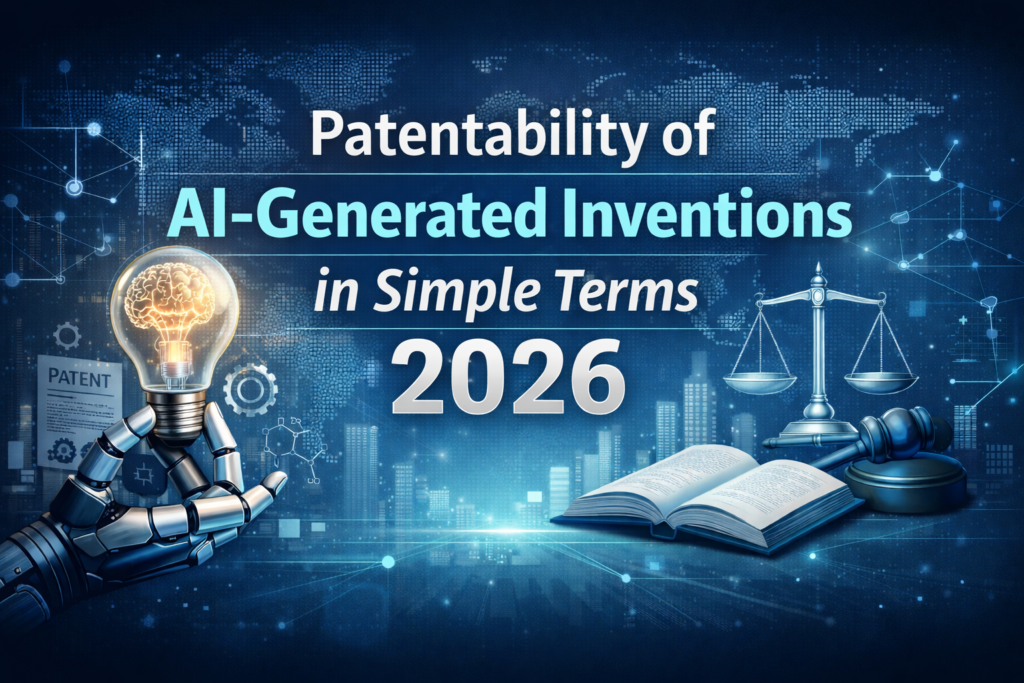
Artificial intelligence is transforming innovation at an unprecedented pace. Machines now design pharmaceuticals, optimize engineering systems, and even generate complex technical solutions without direct human drafting. Consequently, policymakers, courts, and patent offices worldwide are confronting a fundamental question: What is the patentability of AI-generated inventions?
This issue is no longer theoretical. Instead, it shapes the future of research ownership, economic incentives, and technological leadership. Therefore, this article explores the legal foundations, landmark cases, jurisdictional differences, and policy implications surrounding the patentability of AI-generated inventions, while offering practical insights for innovators and businesses.
Understanding AI-Generated Inventions
Before examining legal standards, it is essential to clarify what constitutes an AI-generated invention. Traditionally, human inventors conceived ideas, reduced them to practice, and then claimed patent rights through established legal systems. However, modern AI systems, particularly generative and autonomous learning models, now operate with far greater independence. As computing power expands and data availability increases, these systems can move beyond simple assistance and actively contribute to technical discovery. Consequently, this technological shift forces policymakers and courts to reconsider the patentability of AI-generated inventions within existing legal frameworks.
Modern AI systems can independently:
- Identify technical problems
- Propose novel solutions
- Optimize designs through iterative computation
Moreover, these capabilities continue to improve as algorithms learn from new data and refine their outputs. Therefore, the boundary between human-assisted and machine-generated creativity becomes increasingly blurred. This transformation directly influences the patentability of AI-generated inventions, because traditional patent law assumes clear human inventorship. As a result, legal systems must adapt carefully to balance innovation incentives, ownership rights, and public interest in the age of artificial intelligence.
Core Patent Law Requirements
To evaluate the patentability of AI-generated inventions, one must first consider the universal patentability criteria that apply across most legal systems. Although artificial intelligence introduces new technical and philosophical challenges, these foundational requirements still guide patent examination. Therefore, understanding how each element operates in an AI context becomes essential for innovators, policymakers, and legal professionals. The following principles remain central, yet their interpretation continues to evolve as technology advances.
1. Novelty
An invention must be genuinely new to qualify for protection. If prior art already discloses the same concept, patent protection immediately fails. However, AI systems complicate novelty because they learn from vast training datasets that may include publicly available technical information. Consequently, determining whether an AI output is truly original becomes more difficult. Examiners must carefully trace data sources, algorithmic influence, and generated results. Moreover, hidden similarities between training material and final output may challenge the patentability of AI-generated inventions, requiring more rigorous disclosure standards and improved prior art search methods.
2. Inventive Step (Non-Obviousness)
The invention must also involve an inventive step, meaning it cannot be obvious to a skilled professional in the relevant field. Traditionally, this assessment depends on human reasoning and predictable technical progress. However, AI can instantly evaluate millions of design permutations and identify optimized solutions beyond normal human capacity. As a result, determining what counts as “obvious” becomes increasingly complex. Patent offices must therefore reconsider analytical benchmarks and possibly redefine inventive contribution. This evolving interpretation plays a decisive role in shaping the patentability of AI-generated inventions across different jurisdictions and industries.
3. Industrial Applicability
Finally, an invention must demonstrate practical usefulness in industry. Most AI-generated solutions satisfy this requirement because they often target real-world efficiency, accuracy, or performance improvements. For example, AI frequently advances drug discovery, manufacturing processes, and logistics optimization. Therefore, usefulness rarely blocks protection. Instead, debates focus more on inventorship and obviousness. Nevertheless, clear industrial benefit still strengthens legal arguments supporting the patentability of AI-generated inventions, particularly when applicants provide measurable performance data and concrete implementation outcomes.
The Inventorship Problem
The most contentious issue surrounding the patentability of AI-generated inventions is inventorship. Patent statutes in many jurisdictions explicitly require a natural person to be named as the inventor. Therefore, when an artificial intelligence system autonomously produces a technical solution without direct human conception, significant legal uncertainty arises. Courts and patent offices must then decide whether existing legal definitions can stretch to include AI involvement or whether legislative reform is necessary. Consequently, the inventorship question sits at the center of modern patent debates and directly shapes how the patentability of AI-generated inventions will evolve in practice.
Why Inventorship Matters
Inventorship determines several core legal consequences that influence the strength and survival of a patent. These consequences become even more critical when artificial intelligence contributes to discovery.
- Ownership rights
Inventorship forms the legal foundation of patent ownership. In most systems, rights initially belong to the inventor and then transfer to employers or assignees through contract or law. However, if no human inventor exists because AI generated the invention independently, ownership becomes unclear. As a result, uncertainty over entitlement may discourage investment and commercialization. Clear ownership rules are therefore essential to support confidence in the patentability of AI-generated inventions and to ensure that innovators can lawfully control and license new technologies. - Validity of the patent
Correct inventorship is also a strict legal requirement for patent validity. If an application lists the wrong inventor or omits a true human contributor, courts may invalidate the patent entirely. When AI plays a dominant creative role, determining the proper human inventor becomes difficult and sometimes impossible. Consequently, disputes over inventorship could increase litigation risk and weaken protection. This challenge directly affects the reliability and long-term enforceability linked to the patentability of AI-generated inventions. - Enforcement capability
Finally, enforceability depends on legally recognized ownership derived from valid inventorship. Without a proper inventor, patent holders may struggle to sue infringers or defend rights in court. Therefore, unresolved inventorship questions could render AI-related patents practically useless, further intensifying global debate over the patentability of AI-generated inventions.
Landmark Case: The DABUS Applications
A pivotal global dispute that reshaped discussion on the patentability of AI-generated inventions involved an artificial intelligence system known as DABUS, short for Device for the Autonomous Bootstrapping of Unified Sentience. In this case, patent applications explicitly listed the AI system itself, rather than a human being, as the inventor. Consequently, courts and patent offices across multiple jurisdictions had to confront a fundamental legal question: can a non-human entity qualify as an inventor under existing patent law? This controversy quickly became a defining test for how traditional legal frameworks respond to autonomous technological creativity and continues to influence global policy debates today.
Outcomes Across Jurisdictions
Different jurisdictions responded in markedly different ways, thereby revealing deep international inconsistency in the treatment of AI-driven innovation.
- United States: Courts rejected the application and firmly confirmed that only a natural human can qualify as an inventor. Therefore, the decision reinforced strict statutory interpretation and limited the immediate patentability of AI-generated inventions without human attribution.
- United Kingdom: Authorities followed similar reasoning and concluded that patent law requires a human inventor. As a result, the application failed, further strengthening the human-centered model of inventorship.
- European Patent Office: The office likewise refused recognition of AI inventorship, emphasizing formal legal requirements and procedural certainty across member states.
- South Africa: In contrast, the patent authority granted protection, thereby creating the first formal recognition linked to AI inventorship and signaling openness to broader interpretation.
- India: Indian authorities also rejected the AI inventor designation, maintaining that current law recognizes only natural persons as inventors, while still encouraging policy discussion on future reform.
Taken together, these conflicting outcomes clearly demonstrate the fragmented and evolving global landscape surrounding the patentability of AI-generated inventions.
Comparative International Approaches
Legal systems around the world are actively reassessing the patentability of AI-generated inventions, yet they continue to move at different speeds and in different directions. While some jurisdictions strictly preserve human inventorship requirements, others explore gradual reform to remain technologically competitive. Consequently, this divergence creates uncertainty for innovators seeking global protection and encourages strategic patent filing across multiple regions. The following comparative overview highlights how major jurisdictions currently interpret and apply rules affecting the patentability of AI-generated inventions.
United States
The United States maintains a clear statutory position that only a natural human being can qualify as an inventor. Courts have repeatedly reinforced this interpretation, thereby limiting direct recognition of autonomous machine creativity. However, policymakers and administrative agencies continue to study artificial intelligence and its long-term legal implications. As investment in AI research rapidly expands, pressure for reform may increase. Therefore, although current doctrine restricts the patentability of AI-generated inventions, future legislative or regulatory clarification remains possible, particularly if economic competitiveness or innovation incentives begin to suffer.
European Union and the United Kingdom
European jurisdictions similarly require human inventorship, and authorities consistently reject patent applications that name AI systems as inventors. Nevertheless, regulators actively consult industry stakeholders, academic experts, and technology developers to evaluate whether procedural adjustments could better accommodate AI-assisted innovation. Rather than adopting immediate structural change, Europe appears to favor cautious and incremental evolution. This balanced approach seeks to preserve legal certainty while still monitoring technological progress. Consequently, the regional framework continues to shape a conservative yet adaptable path for the patentability of AI-generated inventions in the coming years.
China
China is rapidly advancing in artificial intelligence research and patent filings, which places it at the center of global innovation policy. Although current Chinese patent law still requires a human inventor, courts and administrative guidance increasingly recognize the significant role of AI assistance in technical development. At the same time, the national strategy strongly encourages AI-driven industrial growth and intellectual property protection. Therefore, China may gradually refine examination standards or disclosure rules to better accommodate machine-assisted creativity. Such developments could meaningfully influence the global direction of the patentability of AI-generated inventions.
India and Emerging Innovation Economies
India currently follows the traditional rule that inventors must be natural persons, and patent authorities have rejected applications listing artificial intelligence as the inventor. Even so, the country strongly promotes AI development through national innovation policy and digital infrastructure investment. As a result, legal debate continues among scholars, industry leaders, and regulators regarding future reform. Many emerging economies face similar tension between strict legal doctrine and the desire to attract technology investment. Therefore, evolving policy discussions in these regions could significantly influence the global future of the patentability of AI-generated inventions.
Policy Arguments Supporting Patent Protection
Many scholars, policymakers, and industry leaders argue that recognizing the patentability of AI-generated inventions is essential for sustaining long-term technological progress. As artificial intelligence becomes deeply integrated into research and development, legal protection plays a decisive role in shaping innovation incentives. Therefore, expanding or clarifying patent rights for AI-driven discoveries may influence investment patterns, knowledge sharing, and global economic leadership. The following arguments explain why supporters consider the patentability of AI-generated inventions both practical and necessary.
Incentivizing Investment
Companies invest billions of dollars in developing advanced AI systems, data infrastructure, and computational resources. Without reliable patent protection, competitors could quickly copy AI-discovered solutions without bearing similar costs. Consequently, investors may hesitate to fund expensive research programs, thereby slowing scientific and industrial progress. Clear recognition of the patentability of AI-generated inventions can strengthen confidence in return on investment and encourage continued experimentation across sectors such as healthcare, energy, and manufacturing.
Promoting Disclosure
Patent systems require applicants to publicly disclose technical details in exchange for exclusive rights. However, if AI-generated outputs cannot receive protection, firms may increasingly depend on trade secrets to safeguard competitive advantage. As a result, valuable scientific knowledge could remain hidden from researchers and the public. Supporting the patentability of AI-generated inventions, therefore, promotes transparency, accelerates cumulative innovation, and enables broader technological learning.
Economic Competitiveness
Nations that recognize and regulate the patentability of AI-generated inventions effectively may attract global research funding, skilled professionals, and high technology industries. In turn, strong innovation ecosystems can drive productivity, exports, and long-term economic growth in an increasingly AI-driven world.
Policy Arguments Against Patent Protection
Conversely, many scholars and regulators warn that expanding the patentability of AI-generated inventions could create significant legal, economic, and administrative risks. Although patent protection may encourage innovation, unchecked expansion might also disrupt competitive markets and strain institutional capacity. Therefore, critics urge policymakers to proceed cautiously and to evaluate long-term societal consequences before broadly recognizing the patentability of AI-generated inventions.
Over-Monopolization
AI systems can generate thousands of technical variations within a short time. If patent offices grant protection too broadly, a small number of technology owners could accumulate extensive control over entire innovation fields. Consequently, excessive concentration of rights may restrict fair competition and slow follow-on research. Limiting overreach, therefore, remains central to debates about the patentability of AI-generated inventions.
Lack of Human Creativity
Patent law historically rewards human intellectual effort and inventive insight. When machines autonomously create solutions, the philosophical foundation of exclusivity becomes less clear. As a result, extending protection without meaningful human contribution may weaken the moral justification underlying the patentability of AI-generated inventions.
Administrative Burden
Patent offices already manage substantial examination workloads. A surge of AI-driven filings could overwhelm review systems, delay approvals, and reduce examination quality. Policymakers must therefore balance innovation incentives with institutional capacity when shaping rules on the patentability of AI-generated inventions.
Possible Legal Solutions
As debate continues, lawmakers and scholars increasingly explore practical reforms that could clarify the patentability of AI-generated inventions while still preserving innovation incentives. Rather than abandoning existing patent systems, many proposals aim to adapt current doctrine through targeted legal and procedural changes. Consequently, these solutions attempt to balance technological progress, fair competition, and administrative feasibility in an AI-driven research environment.
1. Recognizing AI as a Tool, Not an Inventor
One pragmatic approach treats artificial intelligence as an advanced research instrument rather than an independent legal inventor. Under this model, humans who design algorithms, select training data, or direct system objectives would qualify as inventors. Therefore, this interpretation preserves traditional legal structure while still accommodating technological evolution. In addition, it reduces uncertainty in ownership and enforcement, thereby supporting stable recognition of the patentability of AI-generated inventions across jurisdictions.
2. Creating a New Sui Generis Right
Some experts advocate a separate and specialized protection regime tailored specifically for autonomous AI outputs. Such a framework could grant limited exclusivity in duration and scope, thereby preventing excessive monopolization while still rewarding innovation. Moreover, a distinct legal category may resolve philosophical concerns about non-human creativity. By offering balanced protection, this proposal could reshape the future boundaries of the patentability of AI-generated inventions without overextending traditional patent doctrine.
3. Mandatory Disclosure of AI Use
Another widely discussed reform requires patent applicants to disclose the extent of AI involvement in the inventive process. Greater transparency would allow examiners to evaluate novelty, inventive contribution, and ownership more accurately. Consequently, disclosure obligations could improve examination quality and public trust. This procedural clarity would further strengthen responsible governance of the patentability of AI-generated inventions in rapidly evolving technological landscapes.
Industry Case Studies
Real-world industry experience clearly demonstrates how the patentability of AI-generated inventions influences investment decisions, commercialization strategy, and long-term technological progress. As artificial intelligence becomes deeply embedded in research pipelines, legal certainty around patent protection increasingly determines whether organizations disclose breakthroughs or protect them through secrecy. The following sector-specific examples illustrate the practical stakes and broader societal value connected to the patentability of AI-generated inventions.
Pharmaceutical Discovery
AI-driven drug discovery platforms now analyze biological data, predict molecular interactions, and identify promising therapeutic compounds within months rather than years. Consequently, research timelines shrink dramatically while development costs decline. However, pharmaceutical innovation depends heavily on strong patent protection to justify high clinical testing expenses and regulatory approval risks. If AI discovers compounds that cannot secure reliable patents, investors may reduce funding for early-stage research despite clear medical benefits. Therefore, consistent recognition of the patentability of AI-generated inventions plays a critical role in accelerating treatment availability, encouraging collaboration, and strengthening global healthcare resilience.
Engineering Design
Generative design software uses optimization algorithms to create lightweight structures, energy-efficient components, and highly resilient materials that often surpass traditional human engineering intuition. For example, aerospace and automotive manufacturers increasingly rely on AI-generated geometries to reduce fuel consumption and improve safety performance. Yet commercialization depends on enforceable intellectual property rights that prevent rapid imitation by competitors. When patent eligibility remains uncertain, firms may avoid disclosure and instead rely on confidential manufacturing processes. Thus, clearer rules governing the patentability of AI-generated inventions directly support sustainable engineering progress and open technological exchange.
Software and Algorithms
Artificial intelligence frequently produces improved code structures, cybersecurity defenses, and data processing methods that enhance digital infrastructure across industries. Nevertheless, software patent protection already faces legal limitations in several jurisdictions, which further complicates the patentability of AI-generated inventions in the computing sector. This uncertainty can discourage transparency and slow collaborative innovation. Stronger doctrinal clarity would therefore help balance competition, creativity, and public technological advancement in an increasingly software-driven global economy.
Ethical and Philosophical Considerations
Beyond strict legal doctrine, the patentability of AI-generated inventions raises profound ethical and philosophical questions that shape the future of intellectual property. As artificial intelligence systems increasingly perform tasks associated with human creativity, society must reconsider long-standing assumptions about authorship, responsibility, and moral entitlement. These concerns extend beyond courts and statutes, influencing public trust, innovation policy, and the legitimacy of exclusive rights in an automated age.
- Can creativity exist without consciousness?
If AI produces novel and useful solutions without awareness or intention, the traditional link between creativity and human cognition becomes uncertain. This shift challenges how the patentability of AI-generated inventions should be justified in moral as well as legal terms. - Should ownership attach to data, developers, or users?
Because multiple actors contribute to AI outcomes, determining fair ownership requires careful ethical balancing alongside legal analysis. - Does AI challenge the human-centered premise of intellectual property?
Ultimately, expanding the patentability of AI-generated inventions may redefine the philosophical foundation of innovation rights in modern society.
Future Outlook

As artificial intelligence continues to transform research and development, the patentability of AI-generated inventions will likely evolve through gradual legal, institutional, and commercial change rather than sudden global reform. Policymakers, courts, and industry stakeholders are already adapting to technological realities, and their responses will shape the long-term structure of innovation governance. Therefore, several forward-looking trends provide meaningful insight into how the patentability of AI-generated inventions may develop in practice.
- Gradual Legal Adaptation
Courts are expected to interpret existing patent statutes with increasing flexibility while waiting for clear legislative reform. This incremental approach allows legal systems to respond to real technological cases without destabilizing established doctrine. - International Divergence
Because countries adopt different policy priorities, global inconsistency will persist. Companies will therefore make strategic patent filing decisions based on jurisdictions that offer clearer protection for AI-driven innovation. - Hybrid Inventorship Models
Human and AI collaboration will likely become the dominant inventive framework, thereby reshaping how the patentability of AI-generated inventions is evaluated in ownership and contribution analysis. - Increased Regulatory Guidance
Patent offices will continue issuing detailed examination guidelines, thereby improving transparency, predictability, and responsible recognition of the patentability of AI-generated inventions worldwide.
Practical Guidance for Innovators
Organizations that rely on artificial intelligence must adopt proactive legal and strategic practices to navigate uncertainty surrounding the patentability of AI-generated inventions. Because regulatory standards continue to evolve across jurisdictions, careful planning is essential to protect commercial value and maintain competitive advantage. Therefore, innovators should integrate intellectual property strategy directly into their research and development processes rather than treating patent protection as a final step. The following actions can significantly strengthen protection prospects in an environment shaped by the changing patentability of AI-generated inventions.
- Document human contributions carefully
Teams should maintain detailed records of design choices, data selection, model training decisions, and problem formulation. Clear documentation helps demonstrate meaningful human inventive input, which remains crucial for patent eligibility in many legal systems. - Disclose AI involvement transparently
Honest disclosure improves examination credibility and reduces the risk of later invalidation. Transparency also supports emerging regulatory expectations tied to the patentability of AI-generated inventions. - File patents strategically across jurisdictions
Because legal standards differ globally, companies should prioritize regions offering clearer or broader protection to maximize commercial security. - Monitor legal developments continuously
Ongoing review of court decisions, policy reforms, and examination guidelines enables innovators to adapt quickly as the patentability of AI-generated inventions continues to evolve.
Conclusion
Artificial intelligence is transforming how society creates knowledge, technology, and economic value. Traditional patent law, built around human inventors, now faces unprecedented pressure. While most jurisdictions still require human attribution, policy debate continues to evolve quickly.
Balanced reform could protect investment, maintain competition, and encourage responsible disclosure. For this reason, the global conversation about the patentability of AI-generated inventions will shape the future of science, industry, and law.
As technology advances, legal clarity will become essential. Ultimately, thoughtful governance of the patentability of AI-generated inventions can ensure that innovation benefits both creators and society as a whole.
References
- https://www.uspto.gov/initiatives/artificial-intelligence
- https://www.uspto.gov/about-us/news-updates/uspto-seeks-comments-ai-and-inventorship
- https://www.epo.org/en/news-events/in-focus/artificial-intelligence
- https://www.epo.org/en/boards-of-appeal/decisions/j200004eu1
- https://www.gov.uk/government/publications/artificial-intelligence-and-intellectual-property-call-for-views
- https://www.wipo.int/about-ip/en/artificial_intelligence/
- https://www.wipo.int/edocs/pubdocs/en/wipo_pub_1055.pdf
- https://www.saflii.org/za/cases/ZACIPC/2021/1.html
- https://ipindia.gov.in/writereaddata/Portal/News/688_1_AI_and_IP_Consultation_Paper.pdf
- https://www.oecd.org/sti/artificial-intelligence/
FAQs on Patentability of AI-Generated Inventions
- 1. What is the patentability of AI-generated inventions?
The patentability of AI-generated inventions refers to whether inventions created with artificial intelligence can receive legal patent protection under existing intellectual property laws.
- 2. Are AI-generated inventions currently patentable worldwide?
No. The patentability of AI-generated inventions varies by jurisdiction, and most countries still require a human inventor for valid patent protection.
- 3. Why is inventorship important for AI-generated inventions?
Inventorship determines ownership, validity, and enforcement. Therefore, clear human contribution remains central to the patentability of AI-generated inventions.
- 4. How could laws change regarding AI-generated inventions?
Future reforms may recognize human–AI collaboration, require disclosure of AI use, or create new legal rights that influence the patentability of AI-generated inventions.
- 5. Why does the patentability of AI-generated inventions matter for businesses?
*]:pointer-events-auto scroll-mt-[calc(var(–header-height)+min(200px,max(70px,20svh)))]” dir=”auto” data-turn-id=”request-69915a65-95d8-8324-83b8-c12fcdc50006-3″ data-testid=”conversation-turn-46″ data-scroll-anchor=”true” data-turn=”assistant”>